
Table of contents
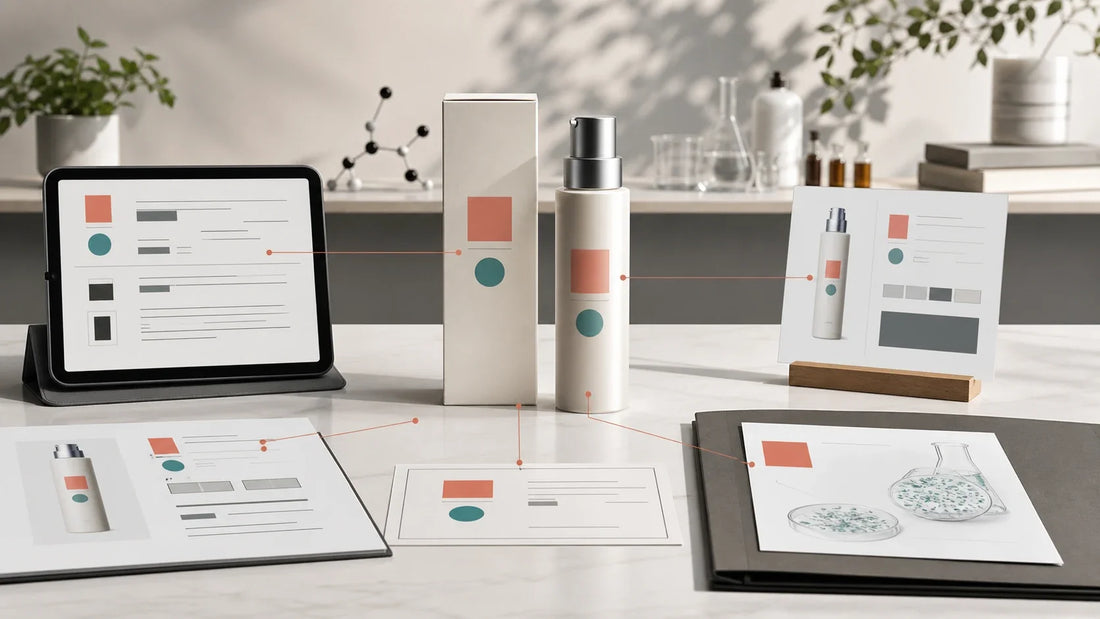
A skincare claim used to travel mainly through packaging, advertising, and a product page. It now also travels through structured data, merchant feeds, retailer listings, conversational search, and AI-generated answers.
The wording may be copied in seconds. The evidence behind it does not travel so cleanly.
Evidence signal this week
AI search is turning claim consistency into product infrastructure. If the label, finished formula, test report, product feed, and retailer copy describe different scopes, better visibility can expose the mismatch faster.
This is no longer a distant search trend. Google reported in May 2026 that AI Mode had passed one billion monthly users globally. Google Merchant Center now also offers optional conversational attributes designed to help AI systems understand product details across AI-driven surfaces.
That does not mean every cosmetic brand needs more copy. It means the product record needs a clearer source of truth.
Search has moved from matching words to resolving product identity
The old content problem
Can the page rank for the right phrase?
The focus stayed on keywords, headings, backlinks, and enough descriptive text to match a search.
The emerging evidence problem
Can different systems identify the same product and the same claim?
The title, formula version, size, image, claim wording, availability, and supporting evidence need to describe one controlled product.
Google's own guidance is practical here. Product structured data and Merchant Center feeds can help Google understand and verify product information. Google also recommends using the same title and description on the feed and landing page.
Structured data is useful. It is not a repair tool for conflicting source material.
Five surfaces can turn one claim into five meanings
| Information surface | Common mismatch | What should remain controlled |
|---|---|---|
| Product label | Short wording removes a condition or qualifier | Exact product identity, intended use, and approved claim boundary |
| Brand product page | Ingredient research is presented as finished-product evidence | Who or what was tested, endpoint, duration, and conditions |
| Merchant or retailer feed | Old title, size, image, or description remains in circulation | Stable ID, current variant data, and matching landing-page content |
| Creator or distributor copy | A cosmetic benefit becomes a treatment promise | Approved wording, prohibited implications, and market limits |
| AI-generated answer | Several public versions are compressed without context | One consistent public record with traceable primary support |
The factory cannot control every answer produced by a search system. The brand can control whether its own product records contradict one another.
An ingredient study is not automatically a finished-product claim
This remains one of the most common scope errors in skincare development. A supplier may provide a study for one ingredient at a defined concentration, in a particular test system, under specific conditions. The marketed formula may use another concentration, another delivery system, and several additional ingredients.
The evidence can still be useful. But the wording must reflect what was actually studied.
Factory-side note
Before approving "clinically tested," ask three separate questions: Was the ingredient tested, was the finished formula tested, and does the proposed sentence describe the same endpoint and conditions as the evidence?

A useful claim record connects the exact finished product to its label proof, evidence source, wording, and market version.
Build a claim record before writing the product page
A claim record does not need to be a large regulatory system. It needs enough structure to stop teams from blending evidence scopes.
01 / Product identity
Record the formula version, package size, variant, SKU, and market. A claim cannot be controlled if the product itself is ambiguous.
02 / Exact approved wording
Store the sentence as approved, including qualifiers. Do not reduce a conditional result into an absolute promise.
03 / Evidence subject
State whether the support applies to an ingredient, a prototype, or the finished formula. These are different evidence levels.
04 / Test conditions
Record the method, endpoint, sample, duration, dose, comparison, and any use condition needed to interpret the result.
05 / Public locations
List the label, website, feed, distributor pack, creator guide, and retailer pages where the wording appears. Version control must reach the channel.
Claim consistency does not remove market boundaries
A perfectly consistent claim can still be unsuitable for a market. In the United States, FDA states that claims about treating or preventing disease, or affecting the structure or function of the body, can make a product a drug under the law even when it is marketed as a cosmetic.
The FTC also looks at express and implied messages. A marketer cannot suggest a benefit indirectly that it could not claim directly, and objective health-related claims need appropriate substantiation.
AI visibility does not change these boundaries. It makes disciplined wording more important because public statements can be found, combined, and repeated more easily.
What buyers should settle before sampling
Buyer checklist
- Name the exact product and market version behind each claim.
- Separate ingredient evidence from finished-formula evidence.
- Approve one wording set for the label, page, feed, and channel guide.
- Record qualifiers, test conditions, and prohibited implications.
- Assign an owner for updating public locations after a formula, package, or claim change.
- Check market classification before turning a cosmetic benefit into stronger language.
AI search does not make weak claims stronger. It makes product information easier to compare. The brands most ready for that environment will not be those with the most claim language, but those with the clearest link between product, evidence, wording, and market.
Data and further reading
- Google, How AI Mode is changing and expanding the way people search, 19 May 2026.
- Google Merchant Center, conversational attributes for AI-driven product discovery.
- Google Search Central, Product structured data.
- US FDA, Cosmetics Labeling Claims.
- US FTC, Health Products Compliance Guidance.
This article provides general product-development and information-governance guidance. Claim requirements depend on the product, wording, evidence, advertising context, and target market.