
Market Watch: Cooling Skincare for a Hotter, More Volatile Climate
By mid-2026, “super El Nino in 2027” is already entering planning conversations. The phrase is useful because it attracts attention. It is also imprecise.
NOAA’s July assessment is more careful. El Nino is strengthening, has a 97% chance of persisting through early spring 2027, and carries an 81% chance of becoming very strong during October to December 2026. An experimental NOAA model goes further, placing the projected peak among the strongest events of the past century. That is a serious signal, but it is not permission to treat every hot-market outcome as certain.
The more durable commercial fact sits underneath the headline. The World Meteorological Organization expects global temperatures to remain at or near record levels over the next five years. Copernicus reports that half of the world’s land area experienced more days than average with at least strong heat stress in 2025. For skincare buyers in Southeast Asia, the Middle East, Latin America, southern Europe, and other heat-exposed markets, cooling is no longer only a summer novelty. It is becoming a question of routine usability.
Market signal
The opportunity is not “cold skincare.” It is skincare designed to remain desirable when heat, humidity, sweat, sunscreen, and air-conditioning all compete in the same routine.
Read the climate signal without overclaiming it
A strong El Nino can shift the odds of heat and rainfall patterns, but it does not create the same weather in every region. NOAA makes that limitation explicit. A buyer should therefore avoid building an entire 2027 range around a single global headline.
| Signal | What the evidence supports | What it means for a buyer |
|---|---|---|
| 2026-27 El Nino | High confidence that the event will strengthen and continue into early 2027; very strong intensity is probable, not guaranteed. | Use it as an urgency signal, then validate climate and retail timing market by market. |
| Five-year temperature outlook | WMO projects 2026-2030 annual temperatures at 1.3°C to 1.9°C above the 1850-1900 average. | Plan cooling and lightweight textures as a repeatable portfolio capability, not a one-season launch. |
| Heat exposure | In 2025, half of global land experienced more days than average with at least strong heat stress. | Treat comfort, residue, layering, and portable use as functional design criteria. |
This distinction matters. Trend-led brands can move quickly without pretending to know the weather two years in advance. The strategic bet is not on one El Nino event. It is on a warmer baseline, more frequent heat disruption, and consumers becoming less tolerant of routines that feel heavy or impractical.
The format decides what “cooling” can mean
A product can feel cooling for different reasons. A light water-rich formula may give a short fresh sensation as it spreads and evaporates. A gel or sorbet cream may feel cool at first, then leave a more protective moisture finish. A mask can turn cooling into a slower reset ritual. These are not interchangeable claims. They are different product architectures.
None is automatically better. They solve different moments in the day. The mistake is to ask for the same cooling story in every format, or to confuse a dramatic first sensation with better long-term use.
| Buyer need | Useful format route | What needs testing |
|---|---|---|
| Fast reset in humidity | Lightweight serum or mist | Spread, absorption time, tack, and makeup compatibility |
| Fresh feel with a moisturized finish | Sorbet, gel-cream, or slush cream | Initial melt, residue, stability, and moisture retention |
| End-of-day recovery ritual | Powder-to-mousse or rinse-off mask | Water ratio, activation, batch consistency, and sachet use |
Three routes, three different product briefs
The serum route is usually judged by speed. A buyer may want a cool, watery first impression, but the formula still has to leave the skin comfortable rather than stripped. In hot markets, the question is often not whether the texture feels light. It is whether it becomes sticky after sweat, layers badly under sunscreen, or disappears too quickly to feel useful.
The sorbet route has a different job. It gives the product more visible texture and a slower, cushionier finish. The brief must balance the fresh scoop-and-melt moment with a stable formula that does not become heavy, oily, or unstable after temperature cycling.
The mousse route changes the use occasion. A powder that turns into a soft mask can turn cooling into a small home ritual. That makes its packaging, water instructions, activation time, and cleanup part of the product experience, not secondary details.

Product formats in practice

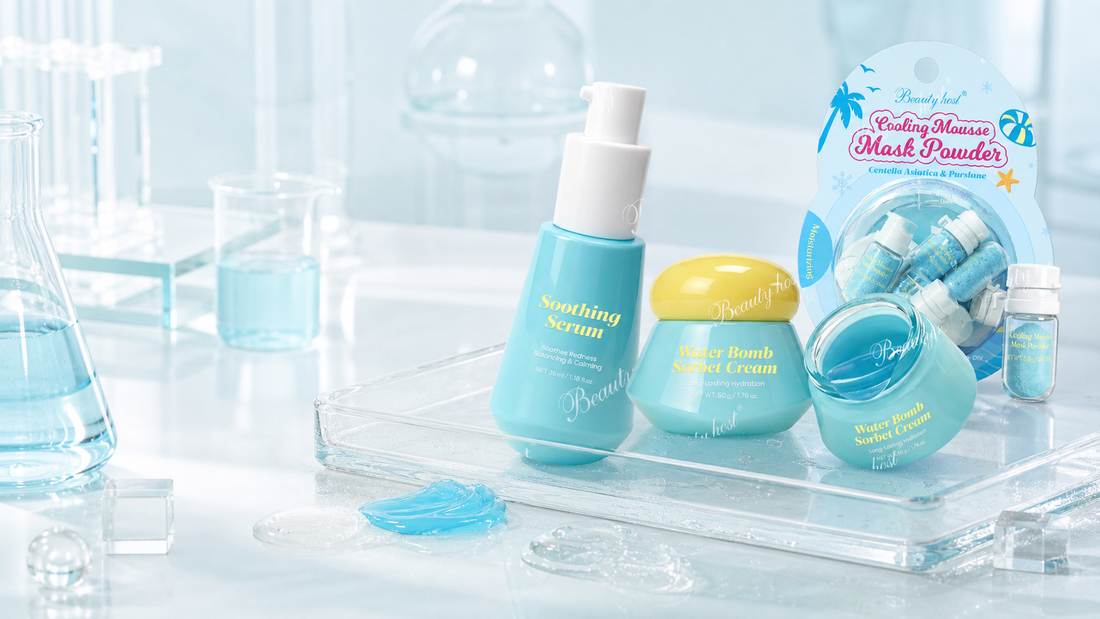
Soothing Serum
A lightweight leave-on route for buyers who need quick absorption and low-residue comfort.

Water Bomb Sorbet Cream
A sorbet-style cream route for a fresh first feel followed by a softer moisture finish.

Cooling Mousse Mask Powder
A powder-to-mousse route for a single-use cooling ritual with a clear preparation step.
What buyers often miss in a cooling brief
Cooling can be pleasant at the first swipe and still fail the routine. A high-water formula may refresh quickly but leave little comfort later. A richer gel may feel good at application but pill under sunscreen. A strong sensate may produce an obvious demonstration, yet become tiring with repeat use or inappropriate for sensitive-skin positioning.
Heat also changes the testing context. A systematic review of skin-temperature studies found that transepidermal water loss rose as temperature increased. This does not mean a cosmetic should make medical or barrier-repair promises. It does mean that “lightweight” should not become shorthand for “insubstantial.” The better brief balances low residue with a credible comfort finish.
Factory-side note
Do not test a cooling formula only on the first touch. Check it after one minute, after the next routine step, and after the sample has been stored through the temperatures it may see in transit. The useful question is whether the formula still feels comfortable when the novelty has passed.
Packaging changes the cooling experience
Packaging is not neutral in a summer brief. A jar helps a sorbet or slush texture look more tangible, but it also makes the scoop, formula recovery, and in-use hygiene visible. A pump may make a serum feel faster and more controlled, yet the output has to match the texture. A sachet gives the mousse mask a clear single-use story, but the buyer still needs to decide how much water the user will add and where that mixing step happens.
The package also changes the cost of the experience. A premium cooling claim can lose value when the pump dose is too small, the jar looks half empty after transit, or the sachet requires tools that the customer does not have nearby. The practical brief should specify the user action, not only the container shape.
How to evaluate a summer-format sample
Test the sample at the same point where the customer will judge it. For a serum, apply the intended dose on warm skin and check whether it stays comfortable after sunscreen. For a sorbet cream, check the first melt, the finish after several minutes, and the texture after warm storage. For a powder mask, follow the real water ratio and preparation time instead of judging the dry powder alone.
Then repeat the test after the sample has rested. Look for separation, viscosity drift, change in scent, package leakage, pump behavior, or a different skin feel. A summer product does not need to feel cold for a long time. It does need to keep the routine easier when heat, sweat, and humidity make a standard texture unpleasant.
What to settle before sampling
- Use moment: morning humidity, midday reset, post-sun comfort, or evening recovery.
- Texture route: serum, gel, sorbet cream, mist, mask, or a two-step format.
- Finish: weightless, dewy, soft, low-tack, or a more protective moisture layer.
- Market climate: dry heat, humid heat, air-conditioned indoor use, or travel.
- Package: pump, jar, sachet, or bottle, plus the expected user dose and storage conditions.
- Testing: stability, texture recovery, layering, package compatibility, and repeat use.
Cooling will have the most staying power where it stops behaving like a claim and starts behaving like product design. For a hot-climate range, begin with the difficult day: high humidity, warm skin, sunscreen already applied, limited time, and low tolerance for residue. Choose the format that makes that day easier. The climate headline may change; the usefulness of the product should not.
Data and further reading
- NOAA Climate Prediction Center, ENSO Diagnostic Discussion, 9 July 2026.
- NOAA GFDL, July 2026 El Nino Predictions. Experimental model outlook.
- WMO, Global Annual to Decadal Climate Update 2026-2035.
- Copernicus Climate Change Service, Global Climate Highlights 2025.
- The Effects of Skin Temperature Changes on the Integrity of Skin Tissue: A Systematic Review.
- Format signals observed in CTKCLIP and Vogue.


